

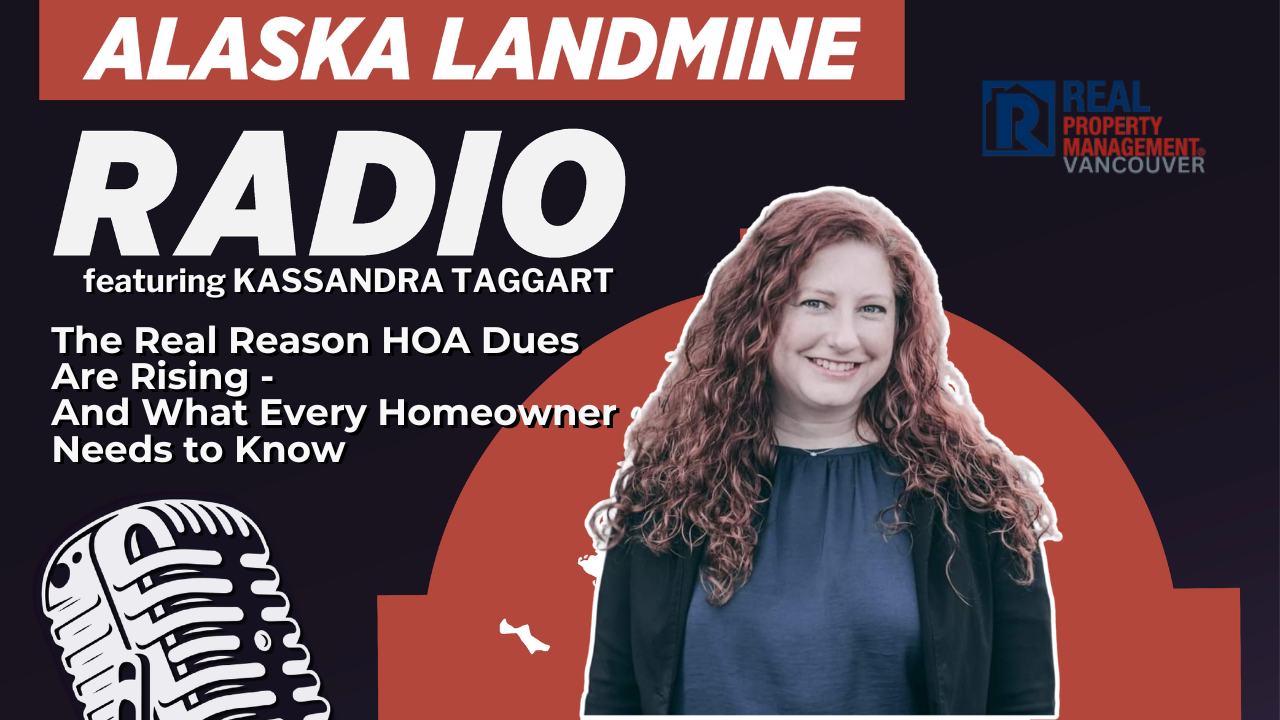
Across Anchorage and the Mat-Su, homeowners are opening their mailboxes to a now-familiar surprise: HOA dues are going up. Again.
Some increases are modest – $25 or $50.
Others are shocking – $150, $200, even $300 in a single year.
Homeowners are frustrated. Buyers are confused.
And many HOAs are on the verge of financial crisis without even realizing it.
So what’s actually going on?
Recently, on Alaska Landmine Radio, Real Property Management Last Frontier’s owner and CEO Kassandra Taggart broke down the truth behind rising dues, underfunded reserves, and the hidden risks impacting Alaska’s condo and HOA communities.
👉 If you prefer to listen, you can catch the full episode at the end of this article.
This article brings together the most important advice, warnings, and insights from that conversation – and gives homeowners a clear roadmap to protect themselves.
HOA Dues Aren’t Rising “Just Because.” There’s a Bigger Story.
For years, many associations kept dues artificially low to “keep owners happy.”
But holding dues flat has consequences – and now the bill has come due.
Here’s what’s really driving HOA dues upward:
1. Insurance premiums have doubled – sometimes overnight.
There are fewer insurers willing to cover condo complexes in Alaska.
Those who remain are charging significantly more.
2. Construction and labor costs have exploded.
A handyman who used to cost $25/hour now costs $115–$130/hour.
Plumbers? Even higher.
3. Building materials and supply chains are strained.
After COVID, everything – from roofing shingles to siding – costs more and takes longer.
4. Aging buildings are hitting critical maintenance points.
Roofs are expiring. Siding is failing. Fire hydrants are breaking.
HOAs that didn’t plan ahead are scrambling to catch up.
5. New federal lending requirements are forcing HOAs to maintain 80% reserve funding.
Without it, FHA, AHFC, and VA loans may not be approved – making homes harder to sell.
Put all of this together, and Alaska’s HOA market is facing the biggest financial pressure it’s seen in decades.
The Most Dangerous Problem: Underfunded Reserves
Think of HOA reserves as the emergency savings account for the neighborhood.
Reserves pay for major expenses like:
Roof replacements
Siding and exterior repairs
Paint cycles
Paving and crack sealing
Crawlspace pumps
Fire hydrants
Plumbing failures
Emergency structural issues
A healthy HOA has 80–100% reserve funding.
An exceptional HOA has 100–120% funding.
But Kassandra revealed a startling statistic:
Only 10% of the HOAs we evaluate in Anchorage are properly funded.
The other 90%?
They’re one broken roof, one fire, or one sewer failure away from catastrophe – often resulting in:
🚨 Special assessments
🚨 Emergency loans
🚨 Rapid dues increases
🚨 Loss of home value
🚨 Loss of loan eligibility
This isn’t fear mongering – it’s the reality of what RPM Last Frontier sees every single day.
When HOAs Don’t Raise Dues, Homeowners Pay Much More Later
One of the biggest misconceptions among homeowners is believing low dues = good HOA.
But in many cases, low dues signal future financial trouble.
Kassandra shared real examples:
📌 A 115-unit HOA that should’ve had $575,000 in reserves…
Instead had $17,000 left because of poor board decisions.
📌 A condo fire that led to a $100,000 special assessment per owner
Because insurance wasn’t properly maintained.
📌 HOAs forced to take out loans
Just to pay for urgent repairs that should have been planned years earlier.
📌 Associations losing FHA/AHFC eligibility
Because their reserves didn’t meet the required thresholds.
Once an HOA loses lending eligibility, only cash buyers and large-down-payment buyers remain – and home values drop fast.
Homeowners Are Shocked Because They Don’t Know What They’re Buying Into
Buying into an HOA isn’t just buying a home – it’s joining a financial system that you inherit the moment you close.
Most owners don’t understand:
How budgets work
What reserves are for
What insurance covers (and what it doesn’t)
How long repairs really take now
Why dues can’t stay flat forever
Why older buildings require higher contributions
And unfortunately, many HOA boards don’t understand these things either.
Kassandra explains:
“Many HOA volunteers are well-intentioned, but they don’t know budget law, contractor requirements, or even Robert’s Rules. It only takes a few uninformed decisions to cost homeowners tens of thousands of dollars.”
What Every Condo Buyer MUST Know Before Purchasing
If you’re thinking about buying into a condo or HOA community, here’s your checklist.
Before you sign anything, review:
✔ The HOA’s financial statements
✔ The reserve study (or ask if there isn’t one)
✔ Insurance coverage
✔ Meeting minutes
✔ Special assessment history
✔ Rules, bylaws, enforcement practices
✔ How many rentals vs. owners occupy units
✔ Whether neighbors are maintaining the property
Most buyers skip all of this – and move in blind.
But buying into a poorly funded HOA can cost more than buying a fixer-upper house.
Because in an HOA, you share the costs with everyone – even if the problem isn’t in your building.
How Homeowners Can Protect Themselves Today
Whether you’re already in a condo or simply exploring options, here’s how to stay safe:
1. Attend HOA meetings – even before you buy.
Yes, you can attend meetings as a prospective buyer.
2. Ask for the HOA’s budget and reserve study.
If they won’t provide it, that’s a red flag.
3. Increase your personal “loss of use” insurance coverage.
Most owners are severely underinsured.
4. Read the bylaws and rules.
They determine how your community is run.
5. Look around the neighborhood.
If the buildings look neglected, they are neglected – and you will pay for it.
6. Work with a professional property manager like RPM Last Frontier.
We help you understand the numbers behind your investment and avoid expensive surprises.
HOA Living Can Be Stress-Free – If the HOA Is Well-Run
Living in an HOA community can be wonderful when:
Dues are properly calculated
Reserves are fully funded
Insurance is adequate
Maintenance is proactively planned
Boards are trained and informed
Unfortunately, few associations operate this way.
That’s why at Real Property Management Last Frontier, our mission is simple:
Protect homeowners, protect communities, and ensure that your HOA is financially prepared for the future – not scrambling to survive it.
🎧 Want the Full Story? Listen to Kassandra’s Complete Podcast Interview
The podcast conversation dives even deeper into:
Real-life HOA disasters
What insurance companies aren’t telling condo owners
How long repairs really take in today’s market
The biggest misconceptions homeowners have about dues
What smart HOAs are doing RIGHT now to avoid financial disaster
👉 Listen to the full Alaska Landmine Radio episode featuring Kassandra Taggart to learn even more.
If You’re a Homeowner, Buyer, or Board Member – We’re Here to Help
Whether you want a second opinion on your HOA’s financial health, need help reviewing condo documents, or want a professional to guide your board:
👉 Visit www.realpropertyvancouver.com
👉 Or contact our team for a consultation.
Your home is likely your biggest investment.
We’re here to help you protect it – and thrive in your community.
This content is provided for general informational and educational purposes only and does not constitute financial, legal, tax, or investment advice. Readers should consult with licensed professionals regarding their specific circumstances.
We are pledged to the letter and spirit of U.S. policy for the achievement of equal housing opportunity throughout the Nation. See Equal Housing Opportunity Statement for more information.
