

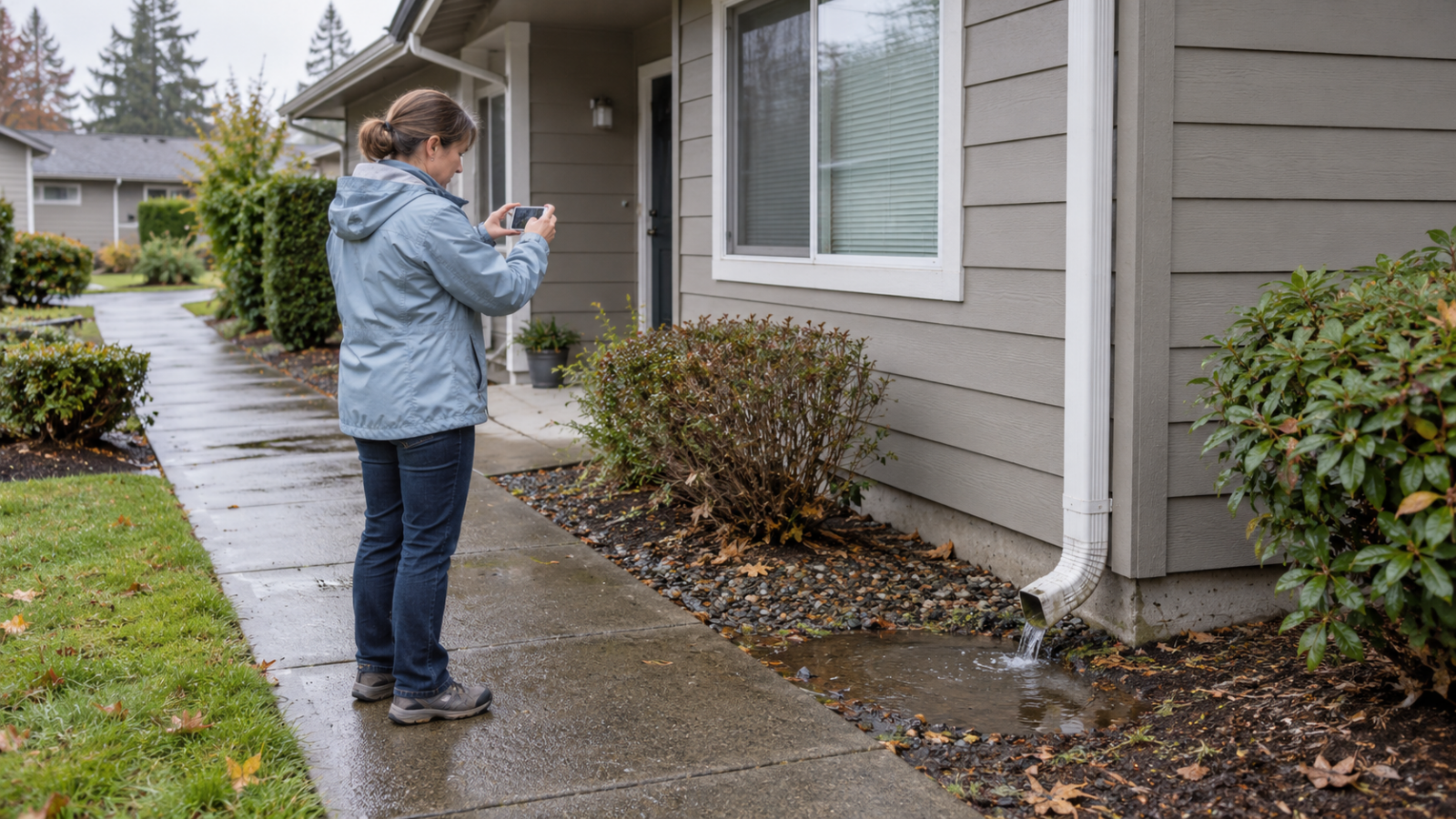
Rain is an easy explanation for a wet walkway or a damp corner near a rental building. In Southwest Washington, it can also become an explanation that stops the next useful question: why is water collecting in that particular place?
The weather may reveal the condition. It does not identify the cause. A Vancouver owner needs a way to move from observation to appropriate evaluation, without assuming that every puddle is a major defect or that every recurring wet area is harmless.
A rental drainage observation process begins with location, timing, repetition, and impact. Those details help a qualified professional understand the concern and help the owner decide what information is still missing.
Observe the Pattern Without Diagnosing It
A single photograph can show standing water. It usually cannot show whether the condition is new, how long it lasts, where the water came from, or what happens during different weather.
Record the date, approximate location, conditions when the observation was made, and any reported recurrence. Describe what is visible. Water remains beside the rear walkway after rain is more useful than the drainage system has failed.
Avoid entering flooded areas, opening drainage structures, climbing roofs, or disturbing building materials to investigate. Safe observation from an accessible location can still provide useful context. Work that requires technical access or judgment should go to the appropriate professional.
Separate Public Drainage From Private Property
A blocked street drain and a wet area beside a building are different concerns. They may interact, but an owner should not assume one explanation covers both.
Clark County’s fall leaf guidance explains that leaves in streets can block storm drains and contribute to standing water. It advises keeping leaves out of the roadway and using appropriate disposal options.
That local guidance supports a simple principle: debris movement matters. It does not diagnose an individual rental’s grading, gutters, downspouts, or private drainage system. Identify who manages the affected area and route the report appropriately instead of assigning work based only on proximity.
Capture What the Water Affects
An isolated wet area in landscaping may need a different response from water affecting an entrance, occupied space, or building material. Include the impact in the observation record.
Useful questions include:
- Is water affecting a normal route into the property?
- Is it collecting beside the building or entering an interior area?
- Has a resident reported an associated issue?
- Does the condition remain after the surrounding area dries?
- Has the same location generated previous maintenance work?
These questions organize the report. They do not replace professional evaluation or establish a universal response deadline. Immediate hazards should follow the appropriate emergency process rather than waiting for a routine property review.
Connect Exterior Observations to Interior Reports
An exterior photo and an interior moisture report may arrive through separate conversations. Keeping them in separate files can obscure a useful connection, even when the cause remains unknown.
The EPA’s moisture and mold guide emphasizes addressing the water problem rather than treating visible mold alone. For an owner, that means a report of recurring moisture deserves a record of the evaluation and the underlying issue identified by qualified professionals.
Do not conclude from a wet exterior area that an interior concern has the same cause. Link the observations as related information and let the professional determine whether a connection exists. Avoid making health assurances or claiming a property is mold-free based on a photograph.
Review Earlier Repairs Before Ordering Another One
If a location has been addressed before, gather the earlier scope, findings, completion date, and follow-up recommendations. A new contractor may need that background to understand what was previously attempted.
The history can reveal that a prior visit only cleared debris, while a separate recommendation for further assessment remained open. It may also show that the current concern is in a different location.
Either finding matters. The objective is to prevent the owner from paying attention only to the latest message while losing the sequence of observations. Maintenance history is context, not proof that a particular vendor caused or solved the condition.
Consider a Hypothetical Camas Example
Imagine a hypothetical Camas rental where a resident reports water near the side entrance after rain. The owner receives one photo, records the location, and asks through the established communication process whether the condition has occurred before.
The property history shows an earlier gutter service and a recommendation to review a nearby discharge point. The owner forwards that history to a qualified contractor for evaluation. The contractor’s findings determine the next scope, rather than the owner assuming another gutter cleaning is the answer.
This example is hypothetical and does not describe an actual client property. It illustrates how a useful record can change the question from what service should I order to what condition needs to be understood.
Make the Scope Match the Finding
Once a professional provides findings, record the proposed work and any remaining uncertainty. A maintenance scope should identify the affected location, purpose, work included, exclusions, and any appropriate follow-up.
Avoid treating a general instruction such as fix drainage as a complete assignment. It leaves the owner, contractor, and resident with different expectations about what will change.
If investigation is needed before a repair can be defined, document that stage clearly. The next decision may be approval for assessment, not approval for an assumed solution. This distinction supports clearer estimates and more useful completion records.
Follow Up Under Relevant Conditions
Some property observations are easier to evaluate when the conditions that revealed them occur again. Ask the qualified professional what follow-up is appropriate and whether additional observations would be useful.
An owner should not invent a monitoring method that exposes residents or staff to unsafe conditions. The purpose is to establish a reasonable review path, with a responsible person and a clear way to report recurrence.
Record what was observed after the work and preserve any remaining recommendation. A paid invoice is one part of the file. It does not answer every question about how the property performs during later rain.
Turn Seasonal Attention Into a Repeatable Record
The same observation fields can support rental properties in Vancouver, Camas, or other nearby communities without assuming every property has the same issue. Start with the actual condition and property history.
RPM Vancouver’s residential management services include maintenance and vendor coordination. A useful management conversation can explain how observations, contractor findings, owner decisions, and follow-up stay connected.
Rain does not need to become a vague explanation that closes the conversation. It can be the condition that helps reveal which question to ask next. For support coordinating that process, explore residential property management with RPM Vancouver.
This content is provided for general informational and educational purposes only and does not constitute financial, legal, tax, or investment advice. Readers should consult with licensed professionals regarding their specific circumstances.
We are pledged to the letter and spirit of U.S. policy for the achievement of equal housing opportunity throughout the Nation. See Equal Housing Opportunity Statement for more information.
